A homelab built to be rebuilt.
The rack beside my desk: seven devices that hold my films, files, photos and backups. Building one is the easy part. Below, everything that can break in it, and what happens when it does.
- Cluster restore
- ~35 min
- Power
- ~65 W at the wall
- Stack
- Proxmox, Talos, Flux
What stands in it
- vault Dell PowerEdge R730xdThe copy. Wakes once a day, pulls the NAS, powers off.
- NAS Synology DS223The live store. Media, files, photos, every backup's landing spot.
- pve-1 Beelink GTi13 UltraThe GPU. Every transcode happens here.
- pve-2 Dell OptiPlex 3050A vote. Power-loss-protected SSD for etcd.
- pve-3 Dell OptiPlex 3050A vote, and the host that wakes the vault.
- pfSense XCY X44Firewall and gateway, behind the shelf's machines.
- UPS CyberPower VP700ELCDPower. The whole estate draws about 65 W.
When something breaks
Seven things that will go wrong one day, and what happens when they do.
A disk dies
Nothing stops.
No disk holds the only copy of anything. The NAS is a mirror, the vault’s twelve SAS disks are one RAIDZ3 that survives any three of them, and Longhorn keeps every app volume on all three nodes.
| Where | Layout | Holds |
|---|---|---|
| NAS · DS223 | 2 × 2 TB, mirrored | the live store: media, files, photos, every backup’s landing spot. 1.1 TB of 1.8 TB used |
| vault · R730xd | 12 × 600 GB SAS, one RAIDZ3, encrypted | history: daily and monthly ZFS snapshots |
| Longhorn | NVMe on pve-1, D3-S4510 on pve-2 and pve-3 | app volumes, one replica per node |
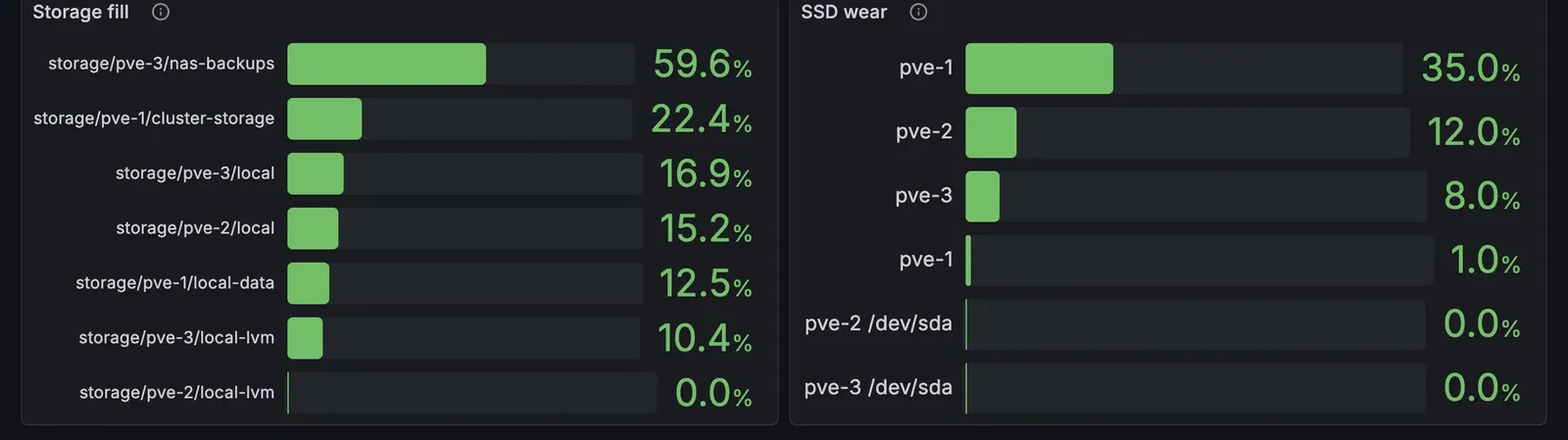
The wear is watched before it becomes a failure: the busiest SSD is at 35%, the D3-S4510s, bought for their power-loss protection, at zero.
A machine dies
The cluster keeps its quorum.
Three standalone Proxmox hosts, one Kubernetes node on each, so the three etcd votes sit in three different chassis. Losing a machine costs a workload, not the cluster: Longhorn already holds a replica of every volume on the other two.
There is no HA at the hypervisor, deliberately. The hosts are joined through Proxmox Datacenter Manager, never corosync: Kubernetes carries the redundancy.
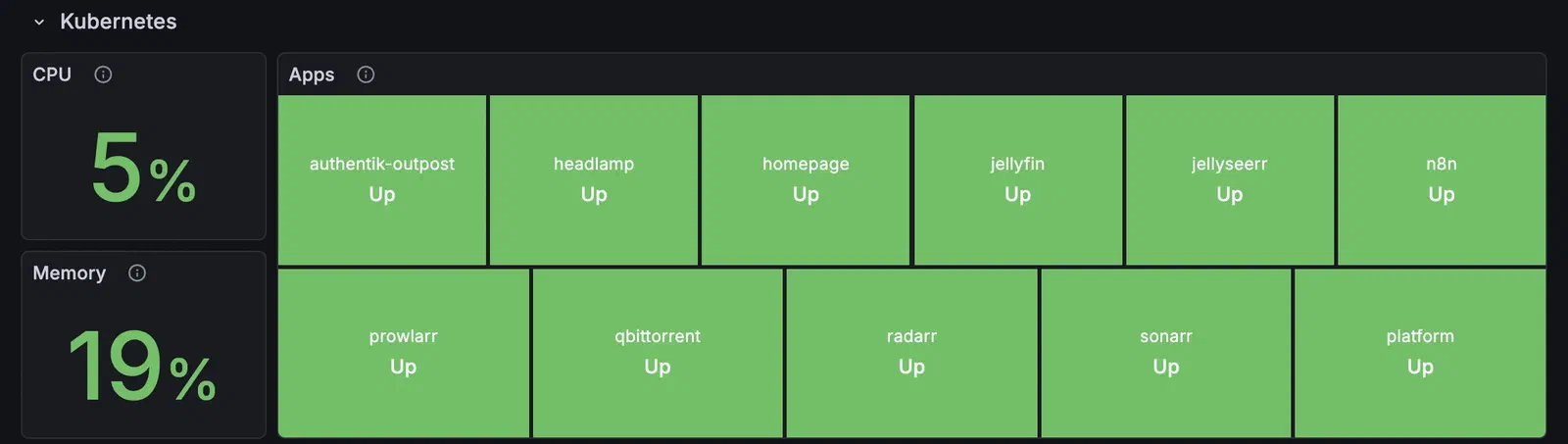
One warning on my dashboard never clears, and it is honest: if pve-1 died, the other two could not hold everything it runs, and the GPU every transcode needs is in it. I know, and I chose three small machines anyway.
The power goes
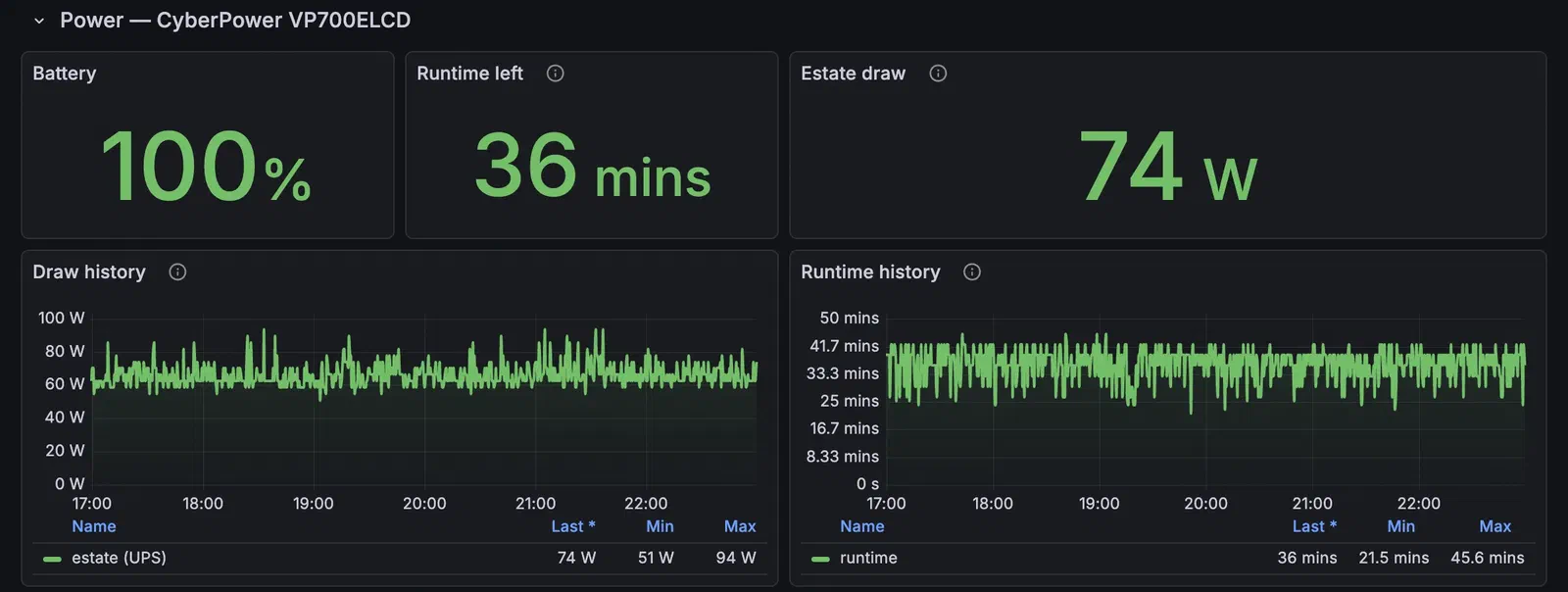
36 minutes on the battery.
Everything stands on one CyberPower VP700ELCD, watched by NUT. A small battery lasts because there is little to carry: about 65 W at the wall, averaged over two days with the vault’s daily run included.
It was about 165 W while the R730xd ran around the clock. I made its twelve SAS disks park whenever nothing read them, and it worked; the story is in Spinning Down SAS Disks. Then I moved the live data to the NAS and let the whole server power off instead. Parking a disk saves a few watts. Not running the server saves all of them.
Someone tries to get in
There is no door.
Nothing in the rack answers the internet. Four pieces see to that.
| pfSense | Firewall and gateway on an XCY X44. Physical segmentation: one NIC per segment, not VLAN tags. |
|---|---|
| Tailscale | A subnet router puts the LAN on the tailnet, so the rack and the cloud VPS share one flat mesh. This is the way in. |
| Cloudflare Tunnel | Outbound-only, one per place that needs it: the cluster, the VPS, and the NAS for Synology Drive, so Drive stays up when Kubernetes does not. |
| Unbound | Recursive resolution, no upstream forwarder, with overrides for the internal names. |
One UDP port is forwarded, for Tailscale’s direct WireGuard connections, and it ignores anything without a key. Every public name arrives through a tunnel that dials out.
A service is hacked
It can spoil its own latest copy, and nothing more.
Every service writes the one thing it owns to the NAS, and that is all it can reach. Nothing holds a credential into the vault, and the copy in Oracle can only be added to; its retention runs on the VPS, never from home.
- NASthe latest onlyevery service writes the one thing it owns here
- vault30 days and 12 monthspulls the NAS read-only, once a day, then powers off
- Oracle Cloudwhat the vault sendsappend-only: cannot be pruned from home
So a hacked service can overwrite its own latest copy and nothing further: the vault keeps the old version beside the new, and a pull that would delete more than 500 files stops before it snapshots anything.
A copy nobody has restored is a hope. On the first of every month the vault restores a sample from Oracle and compares checksums, rather than trusting that it could.
The cluster is gone
It comes back from git.
Talos has no shell and no package manager: it is configured by API and by nothing else. Flux watches the repository and makes the cluster match it. There is no third way to change anything, which is what makes the rebuild time believable. git push is the deploy.
- cluster restore
- ~35 min
- onto different hardware, from git and object storage
- VPS rebuild
- ~15 min
- from nothing
- found by the drill
- 4 + 1
- tooling bugs, and one library excluded from every restore
Drilled on 29 August onto different hardware, then done for real on 1 September. The drill is the point: it found four tooling bugs and one library that had been quietly excluded from every restore for months, none of which a backup report would have shown.
kubernetes/apps/
├── default/         jellyfin, the *arr stack, n8n
├── kube-system/     Cilium, CoreDNS, Intel GPU plugin
├── network/         gateway, Cloudflare tunnel, netboot.xyz
├── observability/   Prometheus, Grafana, Loki, Alloy
└── storage/         Longhorn
Secrets live in the repository too, encrypted: SOPS and age for the cluster, Ansible Vault for the VPS. Three keys cannot be lost; nothing else is irreplaceable.
Nobody is watching
Silence is the alarm.
Alertmanager, Flux, Proxmox and TrueNAS go straight to Telegram: critical and warning only, tagged by layer. Every scheduled job also pings healthchecks.io on its way out, so a job that stops running raises its own hand. Nobody has to notice.
A message gets read once, though, and then it scrolls away. So there is one page for looking on purpose: sixteen numbers that sit neutral on a good day and turn amber or red only when one needs me, and below them every console in the house, each with a dot that is its own health check. It answers only on the tailnet.
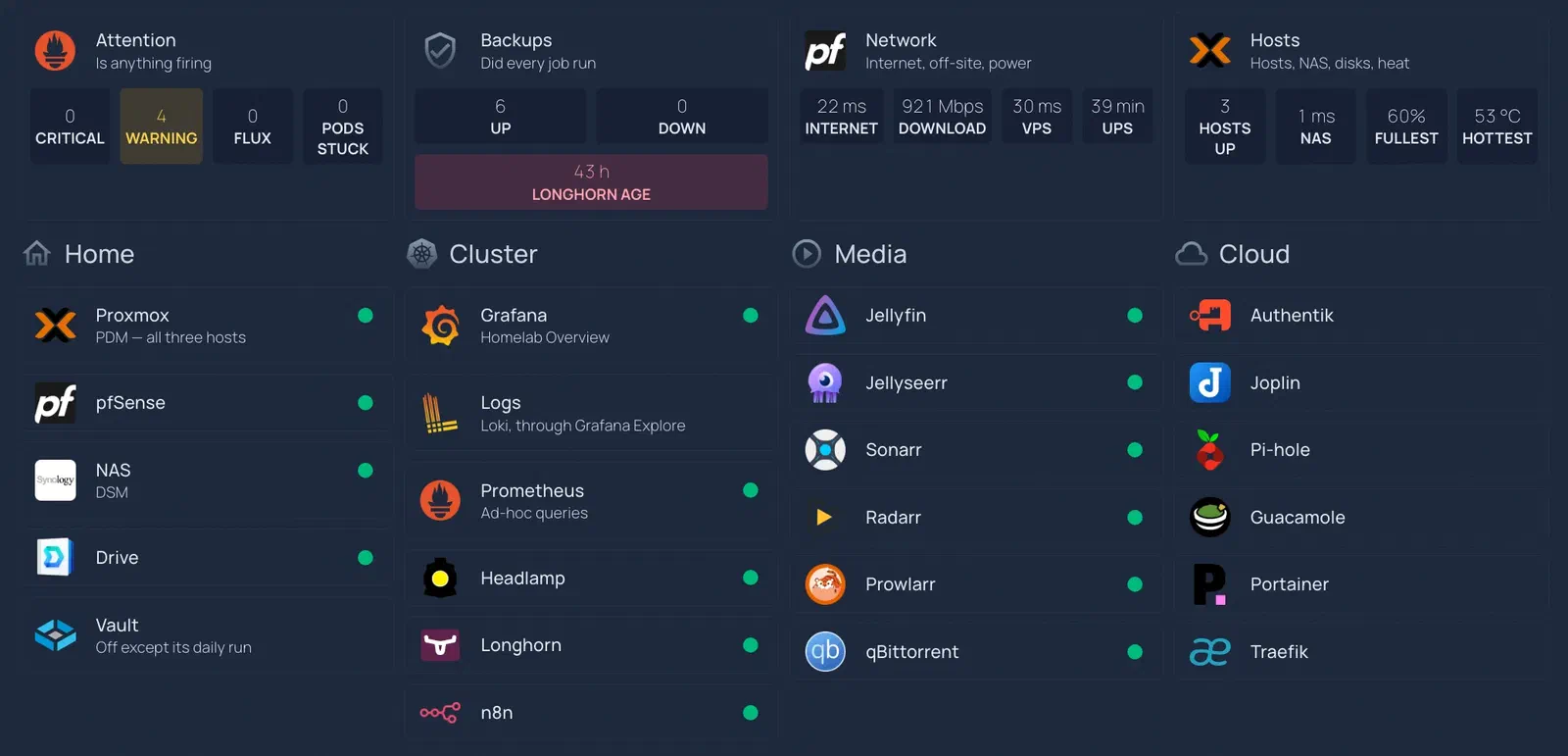
The first evening its Backups card had real data, it showed a job down: the monthly restore drill had been failing since August, Authentik one month, Joplin the next, while both dumps were intact. The drill was racing Postgres’s own start-up. The red in this picture is just as real: one night’s Longhorn backup failed, and the card stays that colour until a good one replaces it.
What it is made of
The machines, what runs on them, and all of it in one table.
The machines
Three small hosts. One big one, asleep.
Beelink GTi13 Ultra
| CPU | Core i9-13900HK · 20 threads |
|---|---|
| Memory | 64 GB DDR5 |
| Node | kubernetes-1 · 14 cores / 32 GB |
| Why | Iris Xe passed through — every transcode happens here |
Dell OptiPlex 3050
| CPU | Core i5 · 4 cores |
|---|---|
| Memory | 32 GB DDR4 |
| Node | kubernetes-2 · 3 cores / 16 GB |
| Why | 960 GB D3-S4510 passed through raw — power-loss protection, the right disk for etcd |
Dell OptiPlex 3050
| CPU | Core i5-6500T · 4 cores |
|---|---|
| Memory | 32 GB DDR4 |
| Node | kubernetes-3 · plus PDM and Garage, Longhorn’s backup target |
| Why | The same D3-S4510, and the host that wakes the vault |
Dell PowerEdge R730xd
| CPU | Xeon E5-2630 v4 · 10C/20T |
|---|---|
| Memory | 251 GB DDR4 ECC |
| Runs | TrueNAS, nothing else |
| Why | Twelve SAS bays for the offline copy. Off about 22 hours a day |
Services
What it actually runs.
Media and automation in the cluster, files and photos on the NAS, identity and remote access on the VPS. Everything with data behind it is declared in the repo.
Media
- Jellyfin: 4K, hardware transcoded
- Jellyseerr: requests, the one route that faces out
- Radarr · Sonarr: film and TV automation
- Prowlarr · qBittorrent: indexing and download, VPN-routed
Files & photos
- Synology Drive: files, synced to my Mac; in a browser from Romania only
- Synology Photos: the photo library, filed by country
- Joplin: notes sync
Platform
- Talos + Flux: the cluster and what reconciles it
- Longhorn: block storage, three replicas
- Cilium: eBPF CNI, Gateway API, L2
- cert-manager: certificates, renewed without asking
Edge & identity
- Traefik: reverse proxy on the VPS
- Authentik: single sign-on
- Guacamole: remote desktop in a tab
- Pi-hole + Unbound: filtering DNS, own resolver
Watching it
- Prometheus: metrics, hosts and cluster
- Grafana: dashboards
- Loki + Alloy: logs
- Alertmanager: straight to Telegram
Odds
- n8n: one workflow, the daily news digest
- Headlamp: Kubernetes, when a UI is faster
- Portainer: the VPS containers
- netboot.xyz: installers over the network
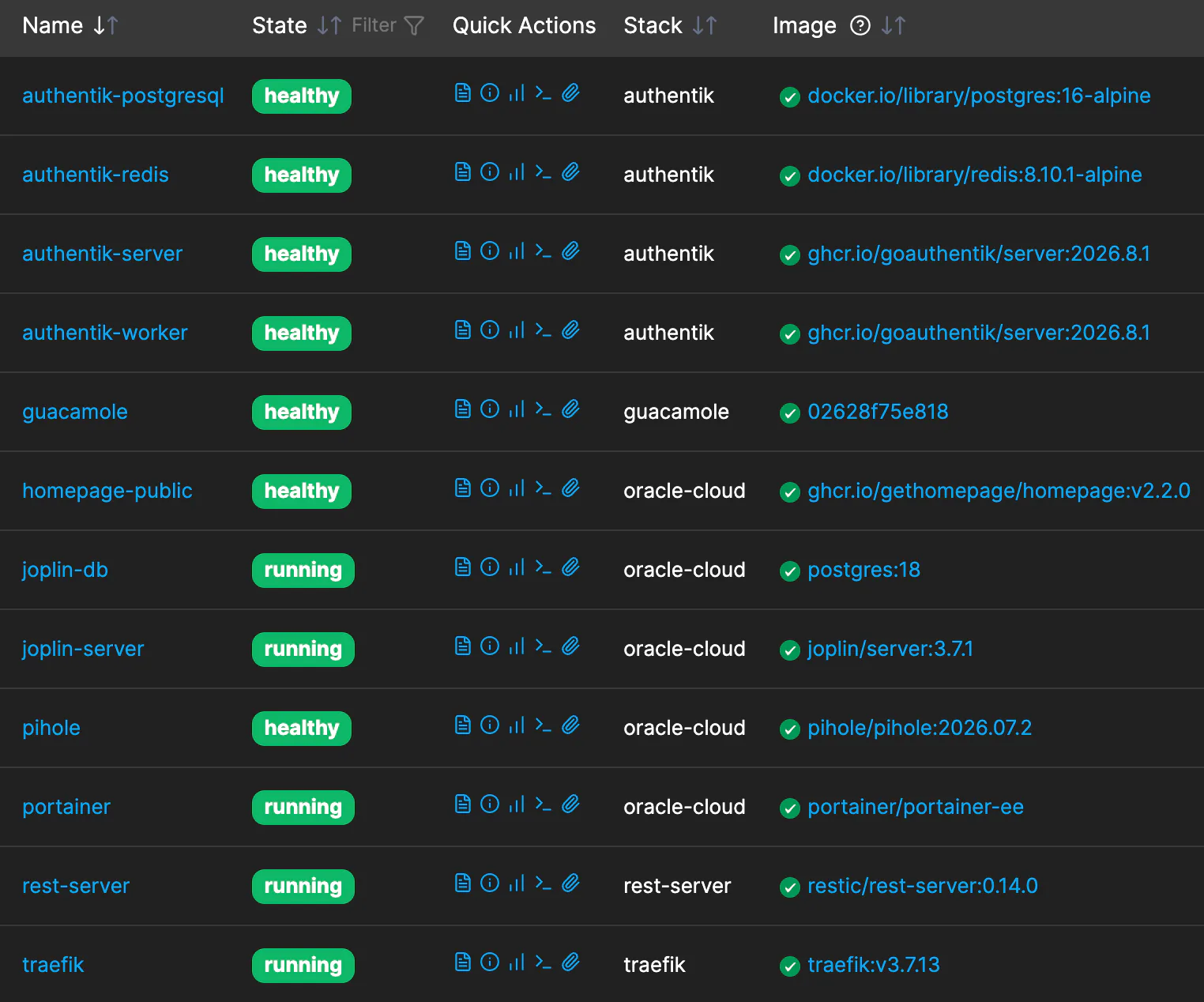
Tech specs
All of it, in one table.
| Hypervisor | Proxmox VE on three standalone hosts, joined by Proxmox Datacenter Manager. No corosync, no HA, deliberately. |
|---|---|
| Kubernetes | Talos Linux, three control planes, one per physical machine. Flux reconciles from GitHub. |
| Networking | pfSense on an XCY X44, one NIC per segment. Cilium for CNI, Gateway API and L2 announcement. |
| Storage | Synology DS223, two disks mirrored. NFS to the cluster nodes only, one rule per client. Longhorn for app volumes, three replicas. |
| Off-site | Oracle Cloud Free Tier, Ampere A1: 4 vCPU ARM, 24 GB, 200 GB. Traefik, Authentik, Guacamole, Joplin, Pi-hole, the public dashboard and an append-only restic server. |
| Offline copy | Dell R730xd on TrueNAS. 12 × 600 GB SAS in one encrypted RAIDZ3. |
| Power | CyberPower VP700ELCD, monitored by NUT. About 65 W in all. |
| Noise | While the R730xd runs, a daemon takes the fans off iDRAC and holds a 1680 RPM floor, about 18 dB under stock. |
Everything on this page is in one repository, and inside.merox.dev shows it running.
meroxdotdev/infrastructureon GitHubThe same, for your servers.
Everything above is what I build for small companies: servers you can rebuild, backups you can restore, alerts before the phone calls.